
If you’re wondering if osteoporosis has a type, she does. If osteoporosis placed an ad in the Wanted section of the local paper, it may read something like this:
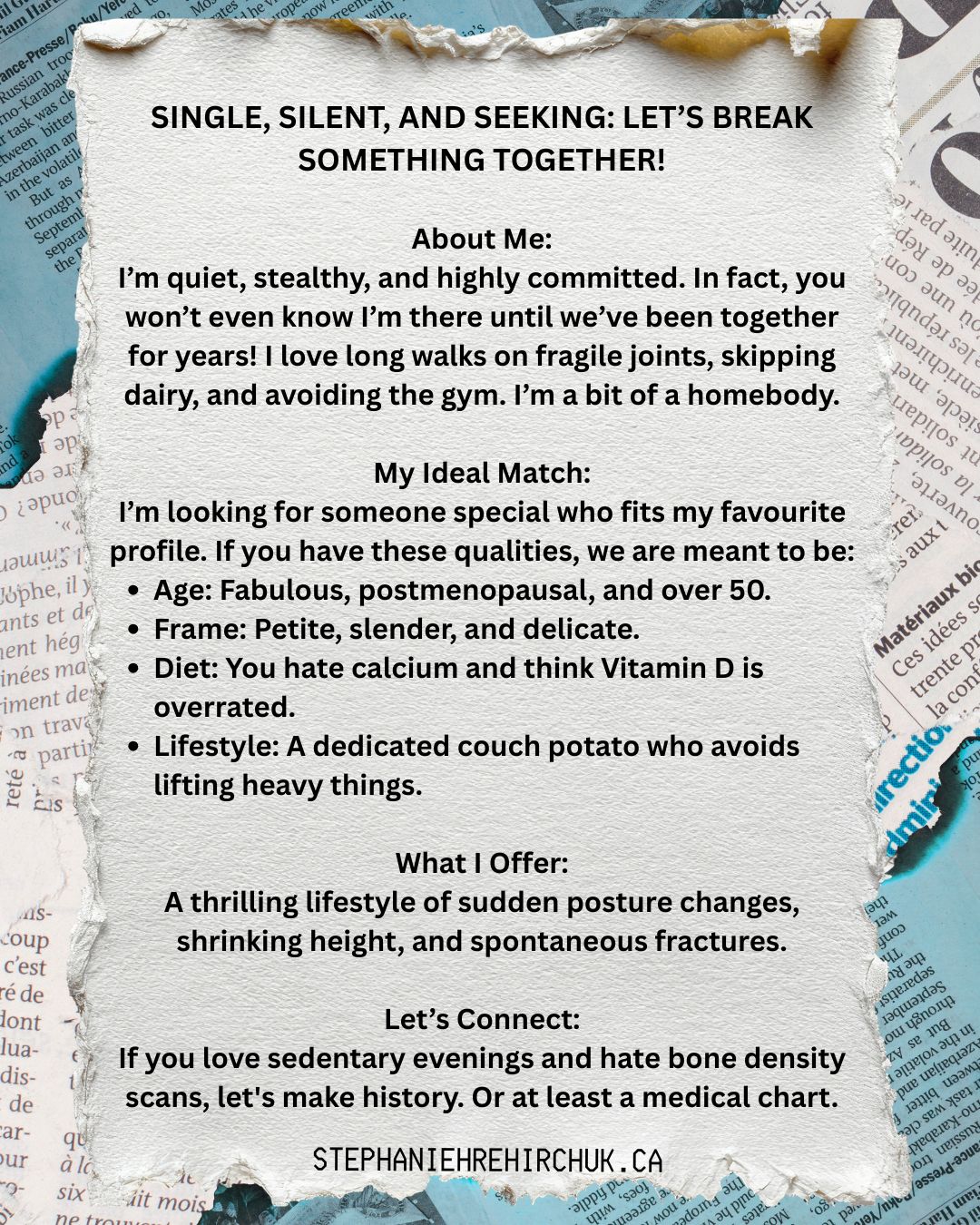
While I’m clearly making exaggerated claims in the above ad for humour’s sake, let’s take a closer look at what the stats show.
Who gets Osteoporosis?
There are some facts and a few falsehoods in the above ad. Osteoporosis can still happen to folks who exercise. It can be diagnosed in those under 50, males, and folks who actively consume dairy.
Osteoporosis does tend to occur most often in postmenopausal women over the age of 50. I’ll share some data with you, keeping in mind that not everyone around the globe has access to screening or proper diagnosis.
According to the International Osteoporosis Foundation:
- Osteoporosis is greatly under-diagnosed in Asia and India
- Worldwide, osteoporosis is estimated to affect 200 million women – approximately one-tenth of women aged 60, one-fifth of women aged 70, two-fifths of women aged 80 and two-thirds of women aged 90.
- Approximately 22 million women and 5.5 million men aged between 50-84 years of age are estimated to have osteoporosis in the EU (2010 figures)
- The number of men and women with osteoporosis in the EU will rise from 27.5 million in 2010 to 33.9 million in 2025, corresponding to an increase of 23%. 1
According to the American Medical Association:
- About 10 million Americans have osteoporosis and another 44 million have low bone density
- Osteoporosis is most common in women, usually affecting 50% of females over the age of 65 and one in four males over the age of 65
- The reason that osteoporosis is more common in females is because of the reduction in estrogen after menopause
- Those who have a family history of osteoporosis are at higher risk
- Females with premature menopause, smoking or heavy drinking history are at increased risk
- Patients who have medical problems like hyperthyroidism, diabetes, vitamin deficiencies and eating disorders are at higher risk
- People who have had bariatric surgery, patients with cancer, celiac disease, autoimmune disease such as rheumatoid arthritis are all at higher risk
- Females with a small body frame have increased risk because they have low bone mass compared to the average person due to their small size
- Corticosteroid use long term can increase the risk of osteoporosis
- And then there are medications you wouldn’t think about like diuretics, which is a common blood-pressure medication, certain seizure medications, blood thinners and even proton-pump inhibitors used for acid reflux can increase your risk of osteoporosis. 2
This is by no means a comprehensive list but more of a quick look into who often gets a diagnosis of osteoporosis.
And a fun fact from the IOF:
In women over 45 years of age, osteoporosis accounts for more days in hospital than many other diseases, including diabetes, myocardial infarction and breast cancer
It’s a pretty wide net cast by osteoporosis. Two main criteria tend to dominate the picture, however: gender and age. It’s interesting to look back at my own health history and see where osteoporosis slowly sidled up next to me.
I was a personal trainer, weight lifter, athlete and health-nut most of my life. Shortly after a cervical spinal injury in the gym at age 44, I went into menopause. I stopped lifting weights due to the ongoing injury and subsequent dysautonomia. It took many years of various approaches before I considered menopause hormone therapy at around age 51.
Early menopause, reduced resistance training (I relied on cycling and some mat pilates that didn’t trigger symptoms), 7 years before hormone therapy entered the picture, and chronic inflammation from the injury, lack of sleep and dysautonomia… it was a bit of a perfect storm window for osteoporosis to slip through.
And it was probably the last thing on my mind.
You can see the stats above vary from source to source (again, differences around the globe in screening and diagnosis), but you also get a fairly clear picture of who gets osteoporosis and why it’s called the sneaky or silent thief. You don’t usually see her coming.
Though I have a feeling she’ll be agreeable to retreating once you finally catch her.
Much love,
Stephanie
Subscribe to the blog to receive the daily posts right in your inbox.
You are also welcome to subscribe to my monthly newsletter:

1 https://www.osteoporosis.foundation/health-professionals/about-osteoporosis/epidemiology

